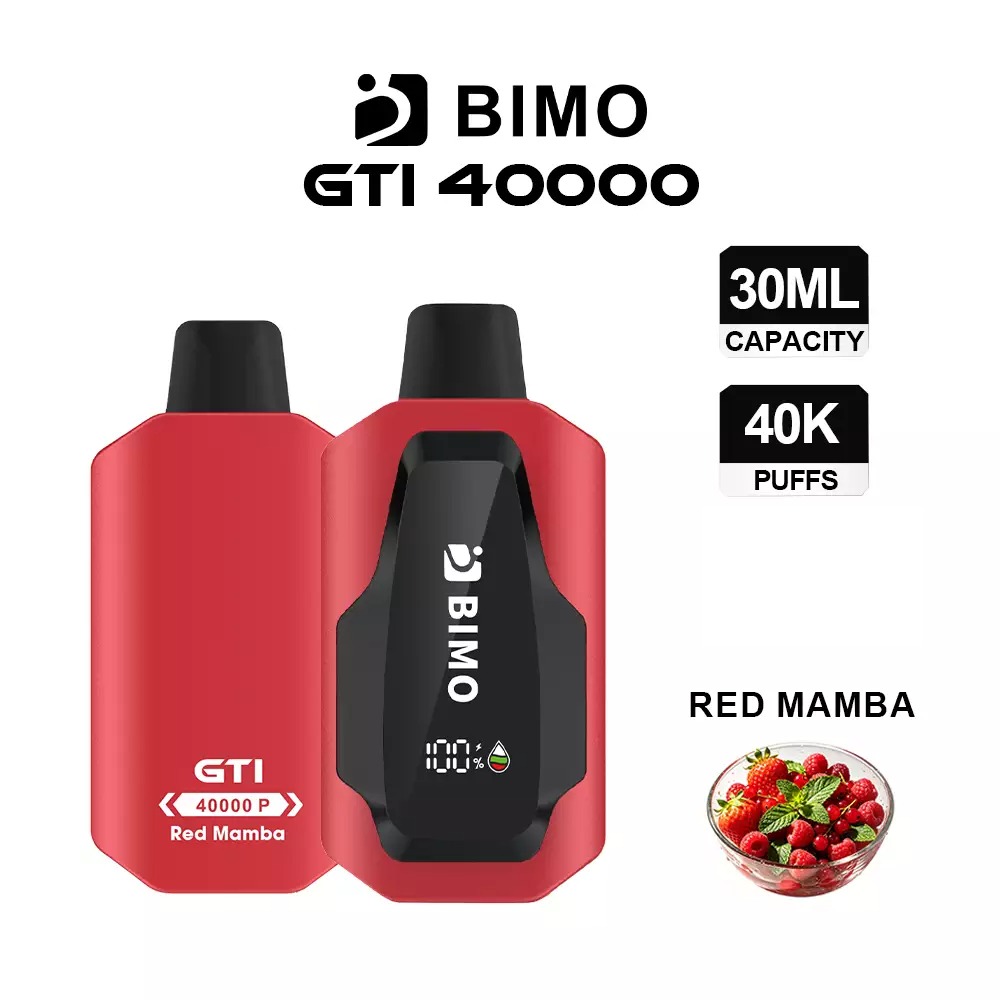

Two lines are worth tracking on every draw: the rise and fall of sweetness, and the rise and fall of tartness against it. Add a third observation, how long the close stays after the exhale, and you have a repeatable way to describe the profile without leaning on a label. Red Mamba on the BIMO GTI 40000 Puffs – Red Mamba is set out below through that sweet-tart curve and its finish length, in neutral terms. All hardware figures come from the supplied Australian listing for this 40000 Puffs Disposable Vape.
Two Lines Across a Single Draw
A single-word verdict flattens a moving picture. Sweetness and tartness each climb, hold and fade at their own pace, so the character of a draw is the gap between the two lines at any position, and reading them apart shows where each peaks and whether they trade the lead.
The finish adds a time axis. Two options can share a sweet-tart shape yet feel different if one clears the palate at once and the other leaves a tail that runs on, so finish length is treated here as a measurement. Australian buyers comparing Disposable Vapes in the 40K class often find the curve and the close more useful than a tasting note copied from a label.
Where the Sweet Line Peaks First
Front of the draw: an early sweet rise
The opening brings sweetness forward promptly at a moderate level, with a rounded, full body rather than a pointed edge. It climbs quickly to a comfortable high and then begins to ease, which marks the sweetness as front-weighted rather than saved for the close.
The peak and its slope
Once it reaches that high, the sweet line does not hold flat; it starts a gentle decline through the middle, losing height slowly. That shallow slope makes room for the second line to become noticeable, giving a rounded shoulder rather than a plateau.
What an early peak suggests
A front-weighted sweet line sets up one question: what does the tart line do while sweetness fades? The outcome mapped here is a tart line that rises as the sweet line falls and eventually meets it.
The Crossover and the Tart Rise
Mid-draw: tartness climbs
Through the middle, tartness lifts steadily while sweetness continues its slow decline. The lift is clean and even rather than sudden or sour, and with the two lines moving in opposite directions this is the most informative moment in the draw.
The crossover point
Where the rising tart line meets the falling sweet line is the crossover, the point the balance turns from sweet-led to even, then faintly tart-tinged. Neither line dominates, and noting where it happens is the clearest way to describe the shape to someone else.
Timing the Close
How long the tail lasts
After the exhale, the close clears in a tidy, finite span, a few slow counts rather than a long, lingering presence. Sweetness drops away first, the faint tart edge follows, and the palate is left clean with little residual weight; counting at an unhurried pace gives a consistent figure across sessions.
Short, even or lingering
On a simple spectrum this option sits near the tidy end: shorter than a lingering, dessert-like tail and longer than an abrupt cut-off. The decline is even, with no late surge of sweetness and no heavy cold layer, so the crossover stays readable to the final moment.
Why the close matters over 40K
On a 40K-format device you live with the close for weeks. A clean, finite finish resists palate fatigue across long sessions, whereas a long cloying tail tires the palate, so the length of the close is a practical part of choosing a daily companion.
A Position-by-Position Curve Map
| Draw position | Sweetness line | Tartness line | Reading of the curve |
|---|---|---|---|
| Opening | Rises to an early moderate peak | Sits low and quiet | Front-weighted, rounded start |
| Early middle | Eases into a shallow decline | Begins a steady climb | The two lines start to converge |
| Crossover | At roughly equal height | Meets, then edges ahead | Balance pivots to even and bright |
| Close and aftertaste | Fades first, cleanly | Clears shortly after | A short, even tail, little residue |
This map describes behaviour, not a recipe. It says nothing about which fruits might be present and everything about how sweetness and tartness behave over time, the only part a draw lets you confirm.
Three Lengths of Finish
Quick-release options
The close clears almost immediately after the exhale, leaving the palate neutral. Easy to return to across a long day, with almost no tail to track or time.
Even-taper options
Sweetness and tartness decline together over a few slow counts, fading evenly rather than cutting off. A measured, balanced finish sits here.
Long-tail options
A noticeable sweetness or cool edge lingers well past the exhale. More intense at first, but a longer tail can tire the palate over a 40K run.
Holding the Measurement Fair
Track two lines, not one impression
Give sweetness and tartness their own sentence in your notes; a single overall verdict hides the crossover, the most recognisable feature of a curved profile.
Count the tail in slow seconds
Time the close with an unhurried count from the end of the exhale to a clean palate, a number is easier to compare across sessions than a vague sense of short or long.
Compare at the same charge level
For a fair reading, compare draws at a similar point in the charge with the airflow left in one position, otherwise the settings become indistinguishable from the curve.
The Hardware That Sets the Curve’s Pace
A curve this even depends on the device repeating itself. The 0.55 ohm Dual Mesh Coil uses twin mesh elements to spread heat across the whole surface for a steady vapour output, so the early sweet peak, the mid-draw tart rise and the short close return in the same order on each draw instead of wandering as the 30 mL internal capacity is used. Two 650mAh rechargeable cells hold that output steady from a full charge down to a low one.
USB Type-C with fast charging support keeps top-ups simple, and a standard 5V/1A adapter is a sensible routine choice. The BIMO GTI Disposable Vape reports device status and remaining capacity on its Smart Integrated Screen, so you can plan a recharge before the output dips. The adjustable airflow toggle shapes the draw: tighter concentrates the front of the curve, more open smooths the peaks into a flatter line.
Device Figures Behind the BIMO GTI 40000 Puffs – Red Mamba Curve
| Product name | BIMO GTI 40000 Puffs – Red Mamba |
|---|---|
| Brand and model | BIMO / GTI 40000 Puffs |
| Device type | Disposable vape |
| Puff rating | Up to 40,000 puffs (estimated maximum) |
| Internal capacity | 30 mL |
| Battery | Dual 650mAh cells, rechargeable |
| Charging | USB Type-C, fast charging support |
| Heating element | Dual Mesh Coil, 0.55 ohm |
| Display | Smart Integrated Screen |
| Airflow | Adjustable airflow toggle |
| Dimensions | 100 mm × 49 mm × 27 mm |
| Option | Red Mamba |
The 40,000 figure is a supplier-stated estimate changed by draw length, how often you reach for the device and the airflow position. The 30 mL internal capacity and the dual cells make that long rating usable in practice, and the short, even finish keeps it comfortable across the run.
Ordering Red Mamba With No Minimum
OZVAPENOW is Australia’s largest online retailer of disposable vapes, working directly with the Australian retail market. BIMO GTI 40000 Puffs – Red Mamba is available as a single unit with no minimum order requirement, which suits anyone who would rather judge the sweet-tart curve and the finish length before stocking up. All stock is original and sourced through manufacturer supply channels.
Orders go out directly from our Australia Warehouse, keeping fulfilment local and delivery quick. Whether this option joins a basket of Disposable Vapes or stands as your first BIMO GTI Disposable Vape in the 40K class, OZVAPENOW keeps the process simple, with local stock and fast dispatch on every order.
Questions on the Sweet-Tart Curve and the Close
How do the sweet and tart lines move from the first draw to the close?
Sweetness peaks early then eases down while tartness climbs; they meet at a crossover and both fade into a short, even close.
Where does tartness catch up with sweetness?
Around mid-draw, where the falling sweet line and rising tart line converge; that is where the balance turns even.
Does this option leave a short close or a long tail?
A short, tidy one. It clears over a few slow counts with little residual sweetness and no heavy cold layer.
How do I time the finish length without special tools?
Count slowly from the end of the exhale to a clean palate, repeating at the same charge level for a steady figure.
Which airflow position flattens the curve most?
A more open setting smooths the early sweet peak into a flatter line; a tighter one concentrates the front.
Can a single unit show me the finish length before I order more?
Yes. Single units need no minimum order, and one is enough to map the curve and time the close.